

- INTRODUCTION
- NWP (NUMERICAL WEATHER PREDICTION)
- THE AI WEATHER FORECASTING MODEL
- WeatherNext (WeatherNext 3)
- USING WeatherNext
- CONCLUSION
I. INTRODUCTION
Sometimes when we wake up, we can know or feel what the weather is going to be like today. We feel this; however, this is actually wrong. We can’t know or feel the weather for today, meaning it is impossible to know the weather for a full day. We can’t predict it without direct experience or data.
We are ready to go out with friends, and it is sunny. So, we think, “Oh, today’s going to be great”. However, suddenly it is cloudy. And we think, “It is going to rain”. And again, the weather becomes sunny and windy. We are frustrated because the weather changes rapidly. This creates a bad situation when we are in a hurry or out for an important job. Even for many ships out at sea, this is so bad. They can’t predict or know the weather beforehand, and it is better to know or predict at least about rain at sea.
So, to be able to predict the weather, many organizations and researchers have built many systems. In this article, we are going to focus on WeatherNext 3, the most advanced weather forecasting model just built by Google DeepMind and Google Research to predict weather every 1-hour.
Before we discuss WeatherNext 3, let’s understand Numerical Weather Prediction (NWP).
NB: The definition of weather in a simple way: “Weather is the current condition of the atmosphere”.
II. NWP (NUMERICAL WEATHER PREDICTION)
As in the name, NWP is based on mathematical equations. To predict the future condition of the atmosphere, NWP uses mathematical models, observations, numerical methods, and high-performance computing. The basic idea is simple: if we have a full description of the atmosphere at present and equations to represent it and describe or show how the atmosphere evolves, then we can numerically calculate the future state. However, in reality, this is very hard because the atmosphere is not linear; it is a continuous, three-dimensional, chaotic system, and the observations and records are incomplete and messy.
NWP treats the atmosphere as a physical dynamic system whose evolution can be described by equations derived from fundamental physical laws. The equations of motion (Navier-Stokes equations) are used to describe how the air moves under pressure gradients, gravity, Earth’s rotation, etc. The continuity equation expresses conservation of mass (mass balance). The Thermodynamic Energy Equation gives the changes in temperature and atmospheric energy. Equations governing the transport and transformation of water describe processes involving water vapor, clouds, and precipitation. So, if we knew exactly the atmospheric state everywhere and could solve these equations, we could determine the future atmospheric state. But in practice, it is not possible.
In brief, NWP has 5 stages. The 5 stages are the Observation Stage, Data Assimilation Stage, Numerical Integration Stage, Post-Processing Stage, and Final Products Stage (Dissemination). In the Observation Stage, data, or we can say observations, are collected from satellites, weather stations, radar, sea buoys, and other systems. In the Data Assimilation Stage, the collected observations are processed, and background checks, optimization, etc. In the Numerical Integration Stage, from the Data Assimilation Stage, a result, which is an analysis (the best estimate of the atmospheric state), is initialized (sometimes we call this the Initialization stage if we add several stages) to produce a model state that is dynamically and physically suitable for numerical integration. Then, numerical integration is done by solving the equations. In the Post-Processing Stage, the output from the ensemble prediction (not just one forecast; it uses an ensemble) is raw and not necessarily the final output because it contains massive arrays of numbers. In this stage, bias correction, statistical calibration, downscaling, interpolation, probabilistic calibration, and conversion into user-oriented formats are done. In the Final Products Stage, the processed output is packaged, exported, and sent out to the public and other organizations. These stages are executed repeatedly.
There are many limitations of NWP. However, we are going to mention only two common and easily understandable ones. The first is the sensitivity to initial conditions. This means that the atmosphere is a chaotic dynamic system, but NWP requires accurate data, which is not possible. Second is the high computational cost. In order to solve the system of equations, NWP requires a lot of resources, which is very expensive.
III. THE AI WEATHER FORECASTING MODEL
When Artificial Intelligence (AI) is in use vastly, weather prediction shifts from explicit physical simulation to data-driven pattern recognition. The shift is just a transition in how we approximate the evolution of the atmosphere. Both of the approaches are trying to solve the same problem: given the current atmospheric state, determine what the atmosphere will look like in the future. The main difference is how they determine or predict the weather.
In NWP, the atmosphere is represented using a set of physical variables, and the evolution of these variables is governed by mathematical equations derived from physical laws. However, in AI weather models, the way of solving the problem is changed. Instead of explicitly calculating atmospheric evolution through a set of equations, people asked if the solution is based on historical data. Using the historical atmospheric states that changes overtime, a neural network can be trained to approximate the mapping. Meaning, the AI models learn a direct mathematical mapping from the past weather data to future weather.
There are many good AI-based weather prediction models; here, let’s consider only three in a very short explanation: GraphCast, Pangu-Weather, and GenCast. GraphCast is a deep neural network weather forecasting model developed by Google DeepMind. It learns from historical data and uses a Graph Neural Network. It can forecast weather up to 10 days and can give warnings of extreme weather. Pangu-Weather is an AI system for weather forecasting developed by Huawei. It is built on a 3D Earth-Specific Transformer architecture to model the evolution of global atmospheric variables. GenCast is an ensemble weather forecasting model. It is based on probability and developed primarily to reduce reliance on a single deterministic forecast.
IV. WeatherNext
WeatherNext is Google’s most advanced AI-based weather forecasting family of models. It is designed to predict the future state of the atmosphere using learned atmospheric dynamics. WeatherNext is a family of models; it includes WeatherNext Graph, WeatherNext Gen, WeatherNext 2, and WeatherNext 3. Our focus will be on the most advanced model that was just published, WeatherNext 3.
IV. 1. WeatherNext 3
WeatherNext 3 is Google’s most advanced AI-based weather forecasting model developed by Google DeepMind and Google Research. It updates the weather every 1 hour using geostationary satellite observations as direct input to the model and produces forecasts at up to 5 km spatial resolution.
Most AI weather forecasting models, including WeatherNext 2, are trained on data from NWP models. However, NWP is expensive, and models are complex. But the WeatherNext 3 is an AI-based weather model. So, WeatherNext 3 is fed a huge amount of live, global geostationary satellite data with ECMWF HRES analysis because weather changes very fast. The model generates a new forecast every hour and forecasts on a 5 km grid. WeatherNext 3 is an ensemble model; it can represent multiple possible future atmospheric states rather than producing only one deterministic prediction.
WeatherNext 3 also addresses some of the previous models’ limitations. Say, WeatherNext 2, it was primarily trained and initialized using analysis data, but this data is estimated using traditional NWP data-assimilation systems. WeatherNext 3 points out three problems: analyses contain biases, especially for variables such as precipitation and surface temperature; operational analyses are produced only every six hours and can therefore be several hours old; and some observations, particularly geostationary satellite observations, are only indirectly assimilated. Since the satellite data are available much sooner than the latest analysis, the model gets access to information about the current atmosphere that would otherwise be several hours old. This is especially useful for weather systems that change quickly, such as precipitation and developing storms.
Another important improvement is resolution. WeatherNext 3 predicts single-level variables at a spatial resolution of 0.1°, with hourly predictions for these variables. This brings its resolution closer to that of high-resolution physics-based global models. It also predicts variables such as cloud cover and solar radiation that were not available in WeatherNext 2. However, it is worth noting that not every variable is predicted hourly. WN3 still uses six-hour outer forecast steps, while some variables inside those windows are predicted at hourly intervals.
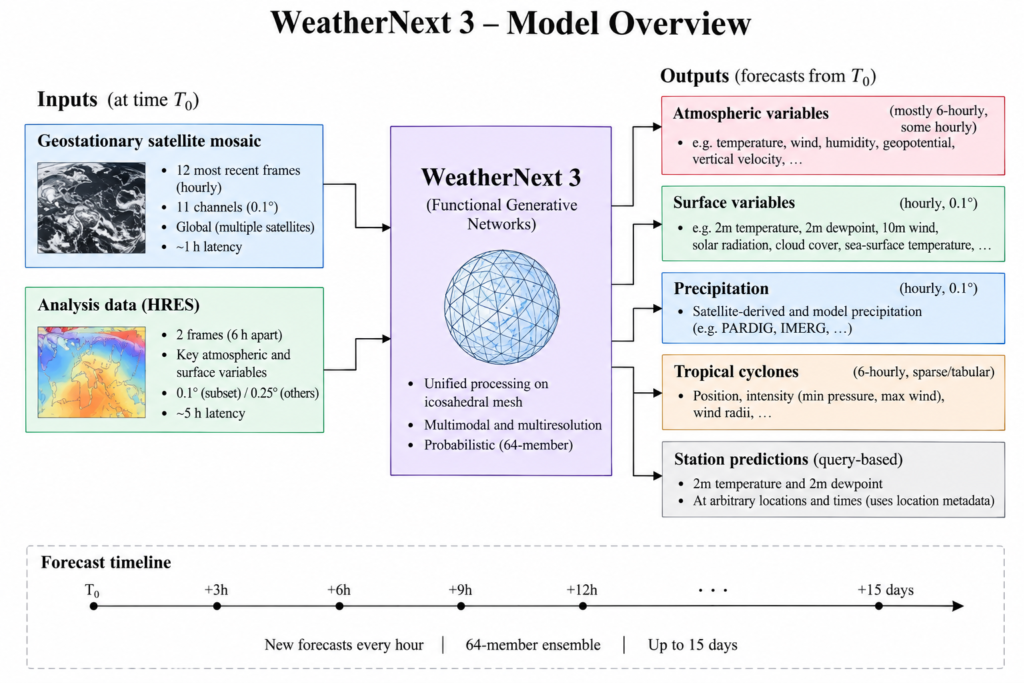
The architecture of WeatherNext 3 is based on an encode-process-decode design and uses the Functional Generative Networks (FGN) approach. One interesting part is that WN3 can handle different types of data at different spatial and temporal resolutions. Instead of forcing every input into exactly the same grid, separate encoders and decoders process the different modalities and connect them through a shared icosahedral processor mesh. This allows the model to work with analysis data, satellite observations and other data sources in their native resolutions while still allowing them to interact inside the model. It is also a probabilistic forecasting model. Rather than producing only one possible future, it produces a 64-member ensemble for forecasts extending to 15 days. The different ensemble members are generated by injecting noise into the model. This is important because the atmosphere is chaotic and there is always uncertainty in a weather forecast. The model is trained using the continuous ranked probability score (CRPS), which evaluates the quality of probabilistic predictions rather than only comparing a single prediction with a single target.
WeatherNext 3 tries to combine some of traditionally separate tasks like data assimilation, numerical forecasting, etc. inside a single learned system. It takes both analysis information and relatively raw, recent observations, learns the relationships between these different data sources, and then produces different types of forecasts from the resulting representation.
V. Using WeatherNext 3
Using WeatherNext 3 is good for a real-time weather forecasting application. However, in this article, we are not going to show how we can use it. The use of WeatherNext 3 will be in the Projects menu in the coming days. The request to use Google’s data requires at least 5 days, so we are going to upload everything about using the model to the Projects menu.
NB: Please subscribe to our Newsletter.
VI. CONCLUSION
Sudden weather changes are not a good feeling. Sometimes we go out without an umbrella, but suddenly it starts raining. So, Google presented the most advanced AI weather forecasting model to predict and forecast weather. Based on previous models, WeatherNext 2, WeatherNext 3 is the best Google has developed that can forecast weather for every hour with 0.05 degrees of resolution.
REFERENCES
Rasp, S., Babenko, B., Masters, D., et al. (2026). WeatherNext 3: Increasing resolution and performance of global weather models with raw observations. arXiv:2609.03582.
Google DeepMind. “Introducing WeatherNext 3, our most advanced and accurate global weather AI model”. https://blog.google/innovation-and-ai/models-and-research/google-deepmind/introducing-weathernext-3/
Google for Developers – Documentation. https://developers.google.com/weathernext/guides/models